
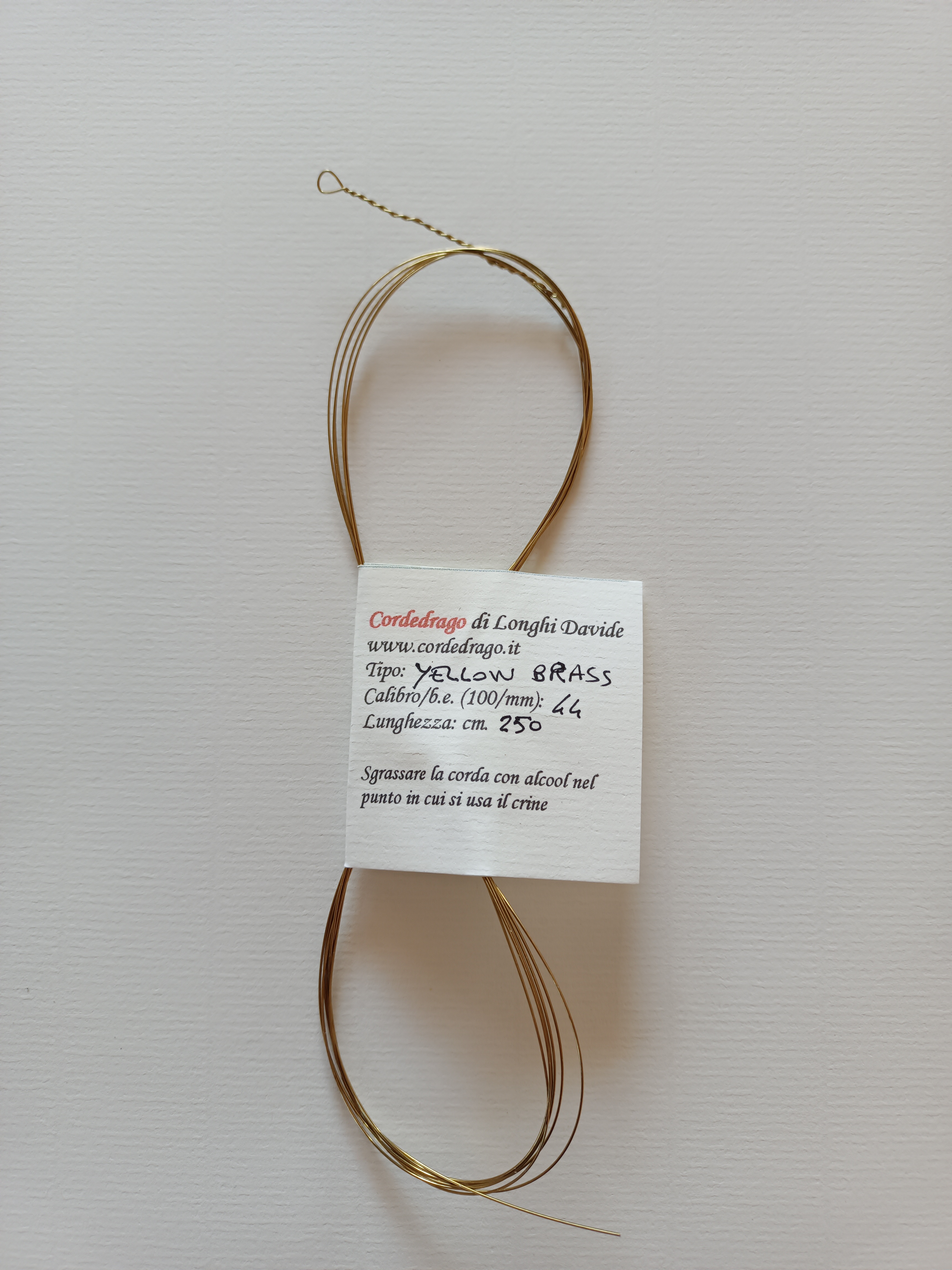
Cordedrago harpsichord strings are the result of a collaboration with master harpsichord maker Roberto Mattiazzo.
Having spent decades not only building harpsichords but also producing and selling strings for the instrument, Maestro Mattiazzo has—upon his retirement—entrusted the continuation of this string-making craft to us.
However, he is not stepping away entirely; he remains our mentor, consultant, and supervisor.
Furthermore, drawing on his decades of experience, he has designed a state-of-the-art workstation for us, featuring diamond-die drawing plates, carbide-hardened (Vidia) spools, and stepper motors to ensure precise tension and consistent wire drawing. The setup also includes an annealing furnace, which is essential for achieving the perfect degree of work-hardening in the strings.
The quality of a harpsichord string depends on several key factors:
1) A pure metal alloy with a perfectly balanced composition.
2) Wire drawing performed at a constant speed and in perfect alignment with the die, preventing the wire from becoming oval-shaped—which would otherwise cause it to sound "false" (out of tune).
3) A complex sequence of drawing stages interspersed with annealing at precise temperatures; because a string on an instrument must be tuned to a tension near its breaking point—without actually snapping—to produce the most beautiful sound, this requires achieving the exact, optimal level of work-hardening.
4) Flawless lubrication during the drawing process, combined with constant cleaning to remove any oxidation caused by annealing.
5) The wire’s resistance to twisting, allowing for the creation of a loop at the end without the risk of breakage.
This process enables the production of strings that offer extraordinary sound quality, alongside a guaranteed resistance to breakage. Moreover, having crafted magnificent harpsichords in the past, the Master has had the opportunity to personally verify the quality of the strings he produces by testing them directly on the instruments themselves.
The materials used are:
red brass (CuZn10, density 8770 kg/m³),
pinkish brass (CuZn15, density 8700 kg/m³),
yellow brass (CuZn30, density 8526 kg/m³),
and soft steel (0.1% carbon, density 7762 kg/m³)—available in two versions: standard and "strong" (the latter being more resistant).
Available formats include:
individual strings with a loop,
2.50-meter lengths without a loop,
and coils of 25 or 50 meters.
For each material and thickness indicated in the following table, it is not advisable to exceed the specified tension:
| Diameter | (mm) | 0.19 | 0.21 | 0.23 | 0.25 | 0.27 | 0.30 | 0.33 | 0.36 | 0.40 | 0.44 | 0.48 | 0.52 | 0.56 | 0.60 | 0.65 | 0.70 |
| CuZn10 | (Kg) | 5.3 | 6.0 | 7.4 | 8.2 | 9.8 | 11.0 | 13.0 | 14.7 | 16.7 | |||||||
| CuZn15 | (Kg) | 6.0 | 6.7 | 7.7 | 9.5 | 10.8 | 12.1 | 13.5 | 15.5 | ||||||||
| CuZn30 | (Kg) | 2.4 | 2.8 | 3.3 | 3.8 | 4.5 | 5.4 | 6.5 | 7.8 | 9.4 | 11.2 | 13.0 | |||||
| Fe C 0.1% | (Kg) | 3.3 | 3.9 | 4.6 | 5.1 | 5.8 | 6.8 | 7.8 | 9.5 | ||||||||
| Fe C 0.1%+ resistente | (Kg) | 5.3 | 6.3 | 7.2 | 8.2 | 9.2 | 10.3 | 12 |