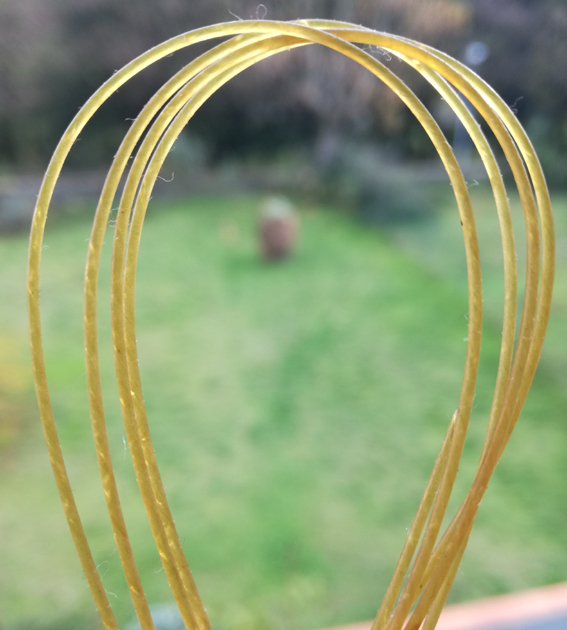
The Cantini di Napoli are strings of extraordinary acoustic performance for the treble and medium register, characterized by a rich and expressive sound.
THE SECRET OF THIS SOUND COMES, AMONG OTHER THINGS, FROM THE USE OF WHOLE GUTS, NOT CUT INTO STRINGS.
I WAS THE FIRST MODERN STRING MAKER TO REPRODUCE THIS ANCIENT PRACTICE, ALREADY AT THE BEGINNING OF MY BUSINESS IN 2013, THANKS TO THE USE OF RAW MATERIALS SELECTED FOR THEIR FINENESS, FOR WHICH IT WAS DIFFICULT TO FIND A SUITABLE SUPPLIER.
IN ROME, PARTICULARLY, BUT ALSO IN NAPLES, THANKS TO THE TRADITION OF SLAUGHTERING VERY YOUNG SHEEP, VERY FINE AND REGULAR GUTS, EVEN CALLED "THREADS," WERE AVAILABLE. WHILE IN THE REST OF EUROPE, WHERE MUCH LARGER AND IRREGULAR GUTS WERE USED, CUTTING OR SPLITTING TO OBTAIN THINNER STRIPS WAS ESSENTIAL. IT IS CLEAR THAT THE QUALITY OF ITALIAN STRINGS WAS SUPERIOR.
Furthermore, thanks to important innovations implemented in 2017, I was able to perfect the drying process of the casings using a specially designed tool, achieving perfect bonding of the individual guts and greater strength.
The name "Cantini di Napoli" derives from the famous cantini (first strings) produced in Naples and exported all over the world (see: Patrizio Barbieri, Roman and Neapolitan Gut Strings). Their sound quality and resistance was famous. They were made exclusively of young lambs in whole gut uncut: three or even four were used to make the first string of the violin. Paganini, in ordering cantini for violin, demands that the Neapolitan string makers make them with four guts.
These were simple twisted strings, and therefore I decided to give the name Cantini di Napoli to all the strings made in whole lamb gut twisted in a non-complex way, including not only the cantini, but also the medium register.
The secret of their sonority derives from the use of whole guts, not cut into strips, because the entire gut in the strings mounted on the instrument is stretched only partially, due to its curved structure (the inner part of the gut is considerably shorter than the one outside the curve), so that the less stretched part makes the string more "open", not obstructing the oscillation during vibration, and making therefore the sound is softer and richer.
But the phase of sulfurization and drying is also of fundamental importance, during which, if carried out correctly, the perfect gluing of the single gut takes place and consequently the creation of a perfectly cohesive, elastic and sonorous string.
I recently invented a machine that simultaneously dries, re-twists and sulphores the strings, as was the case in ancient craft shops, but automatically, with a "smart" process that guarantees the perfect execution of all phases.
Despite the rigor in the selection of the raw material and in the making of the string, however, the actual durability of the Cantini di Napoli used as first strings cannot be guaranteed with certainty, as indeed many iconographic examples in which the violin presents the broken cantino (a metaphorical memento mori), therefore we recommend the purchase of these strings mainly for recordings or for study, given the high acoustic quality, but no responsibility is assumed for any breakage during concerts.
Obviously the above does not regard the use of Cantini di Napoli as second or third strings, given that the tension in this case is much lower and therefore there are no problems of tensile strength.
Finally, for those who want a reliable cantino for durability and resistance, as well as a lower cost, they can use the Ritorte di Salle.
If, on the other hand, you intend to use the Cantini di Napoli in any case, it is advisable to loosen them by a tone during periods when you are not using the instrument, and possibly to fit them whole on the violin, ie not cut in half, forming a skein with the part excess that comes out of the peg, so as to be able to pull a section of string in case of breakage, as can be seen in various iconographic examples (in my experience the string is not really damaged, despite the passage in the peg).
The Cantini di Napoli are, as already mentioned, strings intended for the high and medium register of various plucked and bowed instruments, in particular Baroque violin, Viola, Famiglia viola da gamba, Lute, archlute, chitarrone or theorbo and baroque guitar, as well as a Medieval and ethnic instruments.